
What is Van Westendorp?
Since its introduction in the 1970s, the Van Westendorp Price Sensitivity Meter has been a popular pricing methodology used in market research. Instead of simply asking consumers to identify a dollar (or other currency) amount, this experiment evaluates a range of acceptable prices for your product and offers an optimal price point. It does this by asking four key questions: “At what price would you begin to consider the product so inexpensive that you would question the quality and not purchase it? ""At what price would you think the product is a bargain?""At what price would you say this product is starting to become expensive, to the point that you’d have to give some thought to buying it? ""At what price would you consider the product to be so expensive that you wouldn’t consider buying it?”
While the questions themselves are quite simple, the output is powerful.
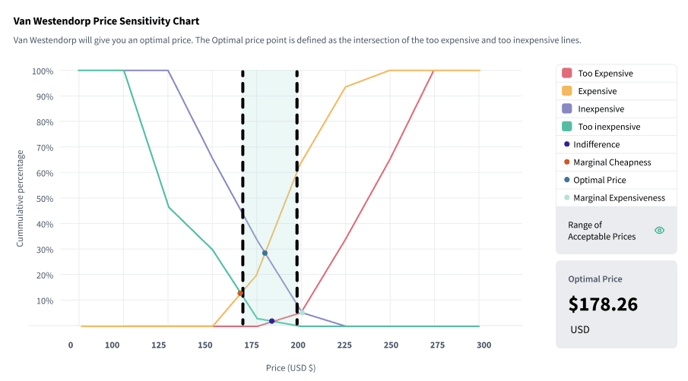
After running a study, the visualization will reveal an acceptable range of prices (highlighted in green in the visualization below). **
“At what price would you begin to consider the product so inexpensive that you would question the quality and not purchase it? ""At what price would you think the product is a bargain?""At what price would you say this product is starting to become expensive, to the point that you’d have to give some thought to buying it? ""At what price would you consider the product to be so expensive that you wouldn’t consider buying it?”
While the questions themselves are quite simple, the output is powerful.
After running a study, the visualization will reveal an acceptable range of prices (highlighted in green in the visualization below). ****
 You don’t have a price range for your offering and would like to explore your options.You would prefer to run a simpler study that will yield straightforward results.
Using Van Westendorp with SightX
With SightX, gauging price sensitivity and solidifying an optimal pricing strategy is simple. After creating a new project, you’ll start in the BUILD section. There you can select “Van Westendorp Pricing” from the add item menu.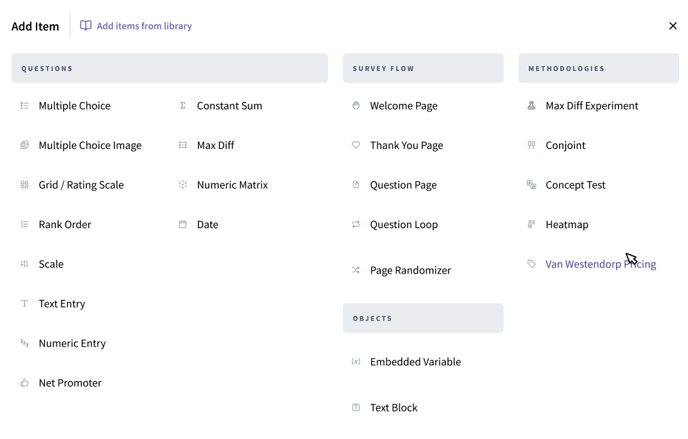
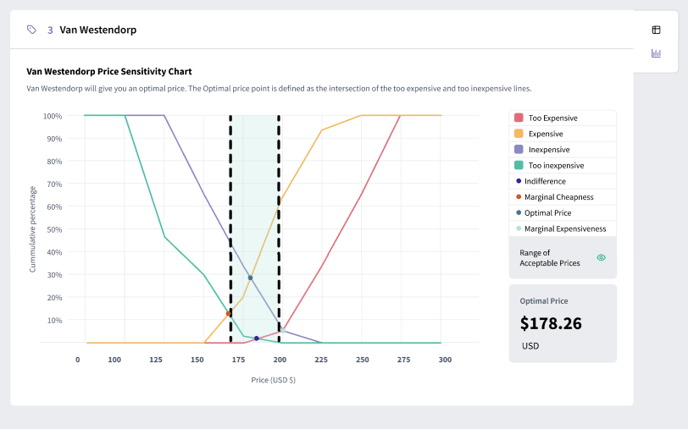
- Too Expensive Line: line plotting responses to the question “At what price would you begin to think the item is too expensive to consider?” with the dollar amount on the X axis and the percent of respondents who entered that dollar amount on the Y axis.
- Expensive Line: line plotting responses to the question “At what price would you think the item is getting expensive, but you still might consider it?” with the dollar amount on the X axis and the percent of respondents who entered that dollar amount on the Y axis.
- Bargain Line: line plotting responses to the question “At what price would you think the item is a bargain, a great buy for the money?” with the dollar amount on the X axis and the percent of respondents who entered that dollar amount on the Y axis.
- Too Cheap Line: line plotting responses to the question “At what price would you begin to think the item is so inexpensive that you would not buy it because it would be poor quality?” with the dollar amount on the X axis and the percent of respondents who entered that dollar amount on the Y axis.
- Indifference Price Point (IPP): the price at which the product is starting to become expensive but still within consideration.
- Point of Marginal Cheapness (PMC): the lowest you can price the product; any lower and shoppers will begin to consider the product too cheap.
- Optimal Price Point (OPP): the ideal price point for the product.
- Point of Marginal Expensiveness (PME): the highest you can price the item; any higher and shoppers will begin to consider the product too expensive.
- Range of Acceptable Prices: this is the range of prices you could use for your product; the bottom range is the PMC and the top range is the PME.
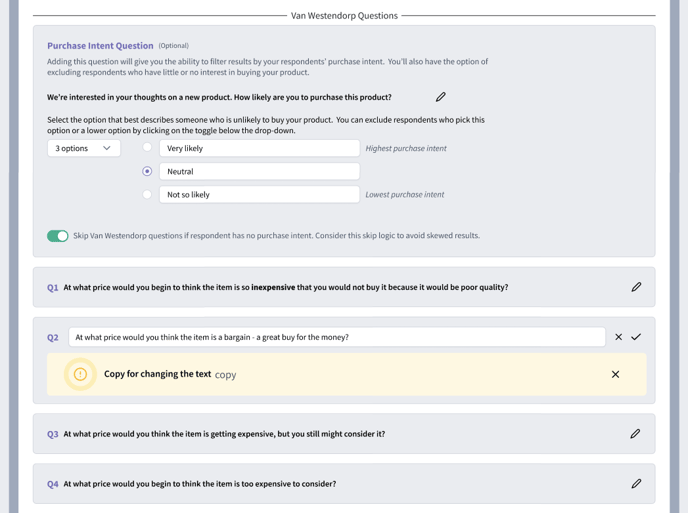
- Use the Purchase Intent question provided or create your own earlier in the survey when setting up a Van Westendorp exercise. In most cases, since the Van Westendorp exercise will assess respondents’ willingness to pay for your product, you will want to only ask people who are likely to purchase your product to assess its price.
- Only display the Van Westendorp exercise to those who are likely to purchase your product. Asking respondents who are unlikely to purchase your product to complete a Van Westendorp exercise could yield skewed results since people who are unlikely to purchase a product might devalue it in comparison to those who would purchase it. If your intention is to see how people who would purchase the product price it in comparison to those who wouldn’t purchase it, then you will want to include everyone in the Van Westendorp exercise, regardless of purchase intent.
- Minimize outliers by setting a minimum and maximum price.
- For robust results, we recommend a minimum base size of 100. Results with fewer than 100 completes are directional.